


An Evolving Segment of Alternative Assets
Collector cars have developed into a recognized segment of the alternative asset market, supported by global auction platforms, third-party data providers, and a growing base of participants that includes collectors, dealers, and investors.
Unlike traditional financial assets, collector cars derive value from factors such as rarity, condition, provenance, and market demand. As a result, pricing and outcomes can vary significantly across individual vehicles and over time.
Key Characteristics of the Market

Finite Supply
Production volumes are fixed and, in some cases, limited. Available supply may decline over time due to attrition or condition changes.
Global Demand
Buyer interest spans multiple regions, including North America, Europe, the Middle East, and Asia.
Auction-Based Price Discovery
Public auctions provide observable transaction data, though pricing may vary depending on timing, venue, and buyer participation.
Specialized Valuation
Vehicle values depend on multiple factors, including provenance, originality, mileage, and historical relevance. These factors are subject to interpretation and may change over time.
Market Data and Observations
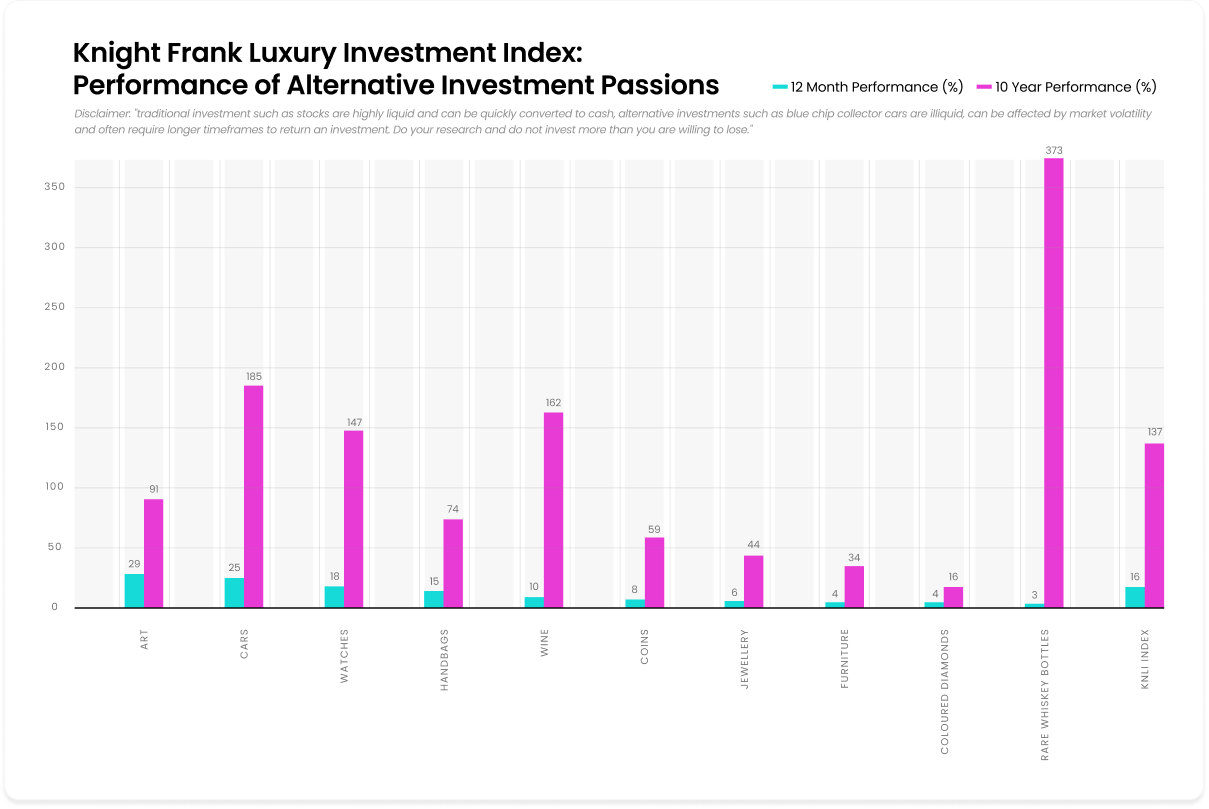
The collector car market is evaluated using a combination of auction results, private sales data, and third-party indices.
Organizations such as Hagerty and Knight Frank publish indices and reports intended to reflect pricing trends across selected segments of the market. These indices are based on specific methodologies and may not represent the broader market or the performance of any individual vehicle.
Auction houses such as RM Sotheby's publish sales results and sell-through rates. These figures reflect activity within their platforms and may not be indicative of overall market liquidity or future demand.

Performance Considerations
Historical data indicates that certain segments of the collector car market have experienced periods of price appreciation. However, results are not uniform and depend on factors including the specific asset, acquisition price, holding period, and market conditions at the time of sale.
Collector cars do not generate income and typically require extended holding periods. There is no assurance that any vehicle will appreciate in value or that an investor will be able to sell an asset at or above its purchase price.
No single index or benchmark fully reflects the performance of the collector car market, and comparisons to other asset classes may not be directly equivalent due to differences in liquidity, fee structures, and market dynamics.
Considerations Within a Broader Portfolio
Collector cars are sometimes grouped with other alternative assets due to characteristics such as limited liquidity and value drivers tied to scarcity and demand rather than income generation.
Investment decisions involving alternative assets should be made in consideration of an investor's individual objectives, financial situation, risk tolerance, and time horizon.

Real Assets and Market Conditions
Some market participants have discussed the role that tangible assets may play in diversified portfolios under certain economic conditions.
Such observations are general in nature and do not represent guarantees of performance. Outcomes for specific asset classes, including collector cars, may differ materially.
Need more information or have more questions? We have the answers.
Get more InformationInvesting in collector cars carries unique risks, such as market volatility where the value of these assets can fluctuate significantly based on trends and collector interest. Liquidity risk is also a factor; unlike stocks or bonds, selling these items quickly without a loss in value can be challenging. Lastly, the limited diversification offered by these assets can lead to higher risk if they form a significant part of an investment portfolio.
The above is just a selection of risks, and there are many more risks associated with investing in our offering. You should read and review the full disclosure of risks associated with investing in our offering, and investing in general, in our offering circular.